Showing posts with label Street art. Show all posts

Saturday, April 16, 2016

Street Art Heading Indoors


“When I go to a gallery, I like to find the art on my own.
Maser

The Irish street artist Maser started his artistic career on the streets as a 15-year-old.

As he explained to Lovin Dublin’s Emma KenneallyIt was a great outlet for a young teen to express himself. No rules, outdoors, exploring the city and painting, ticked all my boxes.

From his teenage tags, Maser soon incorporated typography, letterforms and sign painting into his street work and after studying visual communication at art school his work transitioned to graphic representation and geometric abstraction.

About which he told Berlin Art LinkIt’s very different now, but that could be because I’ve changed too. It was a lot simpler when I started — you wrote your name on a wall, in as many places and as stylized as possible. It was a hobby then, taking up more and more of my time until I realized that I’m an artist and ‘this is what I do. This sub-culture has become something much bigger than I could have imagined, I feel blessed to be a part of it. Exciting times are ahead.

And part of those exciting times has seen Maser travel the world from Australia to Berlin, from the Czech Republic to New York for commissions, residencies and exhibitions. Due to the nature of his work a camera is an import tool in his painter’s arsenal.

As he has said “Photography is essential. Because I work mainly in the public space, anything can happen once I leave the piece. It’s exposed to the elements. Sometimes the photo becomes more precious than the piece. 95% of my outdoor work from over the past 16 years no longer exists. All I have is the photo.

As Maser’s career trajectory moves from the open to the confined so does his presentation of the work.

Maser explained the difference between these approaches with regard to his Olympus Photography commission held in Berlin’s former opera workshop, the Opernwerkstätten. I like to see people react, take notice, and maybe question why it’s there. It especially works in public space because it doesn’t belong there. Space like the Olympus Photography Playground is different, because people come expecting to see art, so I like the idea of narrating their movement by creating an art environment. The piece only has its true purpose when people engage with it and within it.

Be that on the street or in the gallery.


Maser’s latest gallery exhibition Orbiting on the Periphery is currently on show at London’s Lazarides gallery until the 5th of May.


Monday, March 21, 2016

Branding Street Art for the Gallery


“I want my works to be viewed like TV.”
Johnny Romeo


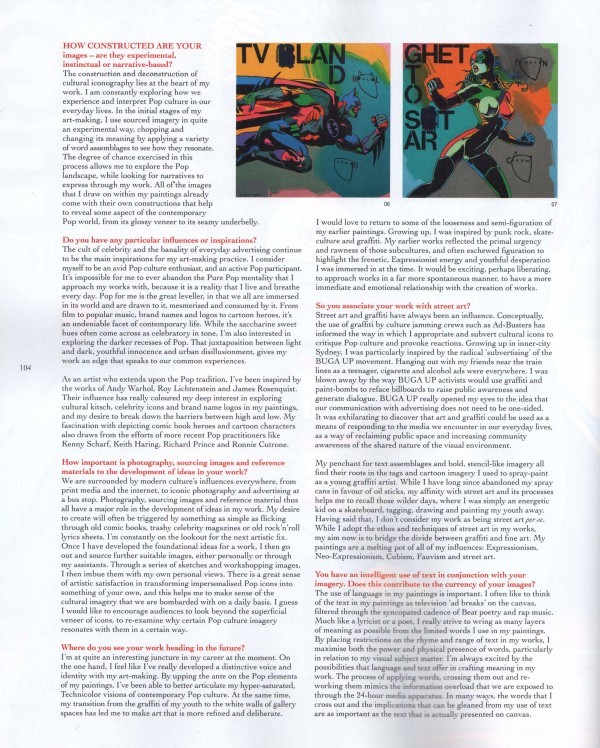
As a teenager, the self-described Neo-Expressionist Pop artist, Johnny Romeo, along with his friends, tagged the inner city streets of Australia’s largest capital city, Sydney.

As he explained to the British magazine Sublime Zine “We were simply reckless, energetic, crazy kids on skateboards tagging, drawing and painting our youth away. We were trying to find ourselves and in doing that, trying also to identify ourselves in the world in which we lived… We were like suburban dogs trying simply to mark our territory.”

Growing up Romeo was drawing constantly inspired by television, magazines, books and journals. “Drawing was something I did every day for fun,” he says.

In particular drawing in front of the TV saw the young Romeo reproduce the stream of images that confronted him, be they program or commercial.

“I grew up watching TV. I was fascinated by the lives and the stories I saw on TV. I was fixated by the catchy persuasive commercials that got inside my head… I was unaware I was living in a constructed television world. I thought it was normal to feel like part of the Brady Bunch family. TV gives us so much fulfillment and we can’t help but relate to the stars and the stories. As a child I did and as an adult I still do… Although today I watch cable and DVDs rather than free to air,” he explained.

After a stint at the University of New South Wales’ Collage of Fine Art, where he was introduced to the work of the American Pop artists of the 1960’s and 70’s, Romeo has stamped his personality onto the genre. Which apart from his use of candy colors Romeo’s use of ironic, parodistic or repetitive text is an integral part of the work.

About which he told the Artist’s Profile magazine “The use of language in my paintings is important. I often like to think of the text in my paintings as television ‘ad-breaks’ on canvas, filtered through the syncopated cadence of Beat poetry and rap music.”

Over the last decade, as Romeo has been building his brand, his work has transitioned from the street to the gallery becoming more planned and structured along the way.

As he says “I don’t consider my work as being street art per se. While I adopt the ethos and techniques of street art in my works, my aim now is to bridge the divide between graffiti and fine art. My paintings are a melting pot of all my influences: Expressionism, Neo-Expressionism, Cubism, Fauvism and Street Art.”


Romeo’s current exhibition When We Ruled the World is on show at Linton & Kay’s Perth gallery until the 4th of April.


Wednesday, September 02, 2015

The Power of Graffiti II


"We want to shift the paradigm of heroism from people with weapons
to ordinary people who actually do something good." 
Kabir Mokamel

The Afghan capital of Kabul is to all intents and purposes is a war zone. And as such the city has become a military base with a mushrooming of towering concrete blast walls designed to protect powerful individuals, government offices, foreign embassies and other international organizations.
This has angered the Afghan artist and graphic designer Kabir Mokamel.

As he told the German Press Agency dpa international "Those who are supposed to protect us are inside the wall. And we are outside the wall, without any security. All the upheaval that you see around is because of the people on the other side of the wall. We have so many security walls in Afghanistan, especially in Kabul, which makes the whole city extremely ugly. If we put images on them, it would at least beautify the city, to some extent, with some really good messages for change."

Born in 1968, the 47 year old sought refuge in Australia in his early twenties before the country introduced its draconian anti-refuge stance. Whilst there Mokamel gained a Diploma in Fine Arts from Seaforth TAFE in Sydney and then went on to study graphic design at the University of Canberra. Four years ago he returned to Afghanistan.

As he told Al Jazeera English "Psychologically, when I come into Kabul I feel under siege. So we're painting some strategic pieces of art in order to educate the public. When you put a picture on a wall, the wall disappears and you are in a new space, that's very important for me."

The latest work An Ordinary Hero - the hero of my city (see above) depicts street sweepers and adorns the blast walls protecting the Afghan Central Bank.

Taking about two weeks to complete, the self-funded project saw volunteers flesh out Mokamel’s design.

"They are just passers-by, they're curious about what we are doing. Sometimes they have a bit of apprehension and we just invite them to come and paint," he says. "They always say they have never painted in their life, we say, just try it, and then they do and some come back the next day."

The self-funding aspect of the project is also very important to Mokamel.

"I want to tell to the international community that we can do this campaign by ourselves, seriously. We just need their moral support, not their money anymore,” he states.


“It's time for Afghanistan and for the world to contribute something else other than weapons and war. We have been through war for the past 36 years, it's really time to give art and artists a chance." 


Wednesday, July 08, 2015

Taking the Street into the Gallery


“There’s no such thing as ‘street art’ inside a gallery.
Pahnl

Like his world famous colleague Banksy, the Oxford street artist Pahnl has adopted a pseudonym that he clings to tenaciously. As he elaborates on his website “I took the word 'panel' as in 'comic panel' and misspelt it to change it from a noun to a name. You could say I see surfaces and spots in the street as panels to drop my characters into but I might be romanticizing the process a little too much.”

Coming from a graphic art background, Pahnl has developed a unique graphic language to depict the antics of his often miniature figures. As he explained to Twig & BoatI would describe them as a mixture of street signage aesthetic and comic narrative, all in a subversive miniature form. Using stencils allows me to spend hours tweaking the pose of a figure or animal and then the act of painting is very quick, something quite visceral.

A process he elaborated about in a Graffiti Street interview saying “I like dropping little figures into the street and seeing how long they last. Survival of the most interesting! I’m not precious about street work in any way. I used to do a lot of stenciling directly on the street, in the daytime, in fact. These days I use clear vinyl stickers that I’ve stenciled earlier in my studio. It affords me more detail and more than one layer. But yeah, if something is torn down after an hour, it’s all good. I usually get a photo of a figure if it’s a good spot.”

But such is the interest in his work that in a little over a decade Pahnl’s works have gravitated from the street to internal white walls of established venues. As he told the Chasseur website in 2013 “I think of myself as an artist, not just strictly a street artist, as that term seems limiting…To be fair, I’ve not hit the streets that much lately and that may have something to do with having gone ‘full-time’ as an artist half a year ago and securing a solo show soon after. I’ve just not had the time to get my stuff out on the street.”

That exhibition Do Look Down - A sprawling stenciled city graced the walls the London West Bank Gallery for a week before being painted over. This was followed by his current exhibition A History of Us at Coventry’s Herbert Art Gallery & Museum. As Pahnl explains “This show has been two years in the making and was stenciled directly onto the gallery walls using 1,107 stencils in the space of nine days! …Each of the 282 entries in the timeline has its own caption. Some of the captions are the truth, some are outright lies and others are a mix of the two.” 

Whilst some may consider that street art cannot exist in a gallery, Pahnl is pretty relaxed with the idea. As he told The Independent Newspaper "Graffiti writers and taggers see anybody who enters the gallery environment as selling out. But street artists embrace the idea more, often because they have a fine art background."

But be it on the street or the gallery wall Pahnl’s works express his underlying ethos. As he has said “The one thing I can confidently attest to is that, like me, my work seeks to be happy and spread happiness. It’s not a deep rationale, I’ll be the first to admit that, but if I’m going to spend the majority of my time working on something, I don’t want it to drag me down. I also don’t bring moral issues or politics into my work because I don’t believe art is a force of change.


A History of Us is on show until the 4th of October.